Klarna now resolves two-thirds of its customer service tickets without a human involved. That didn’t happen because their algorithms got slightly better. It happened because they changed the type of tool they were using entirely. Most business owners, when they start looking at this space, assume chatbot and AI agent mean roughly the same thing. They don’t. Pick the wrong one and you’ve either spent £80,000 on a system you didn’t need, or you’ve launched a basic chat widget that hands your customers a help article when they asked you to cancel their subscription.
You would be surprised at how often that second scenario occurs. It’s also a reliable way to make customers angrier than if you’d done nothing at all. This guide covers the actual differences, what each type of system costs to build and run, and the framework we use at TekScrum to figure out which one a business actually needs.
How are artificial intelligence agents different from chatbots?
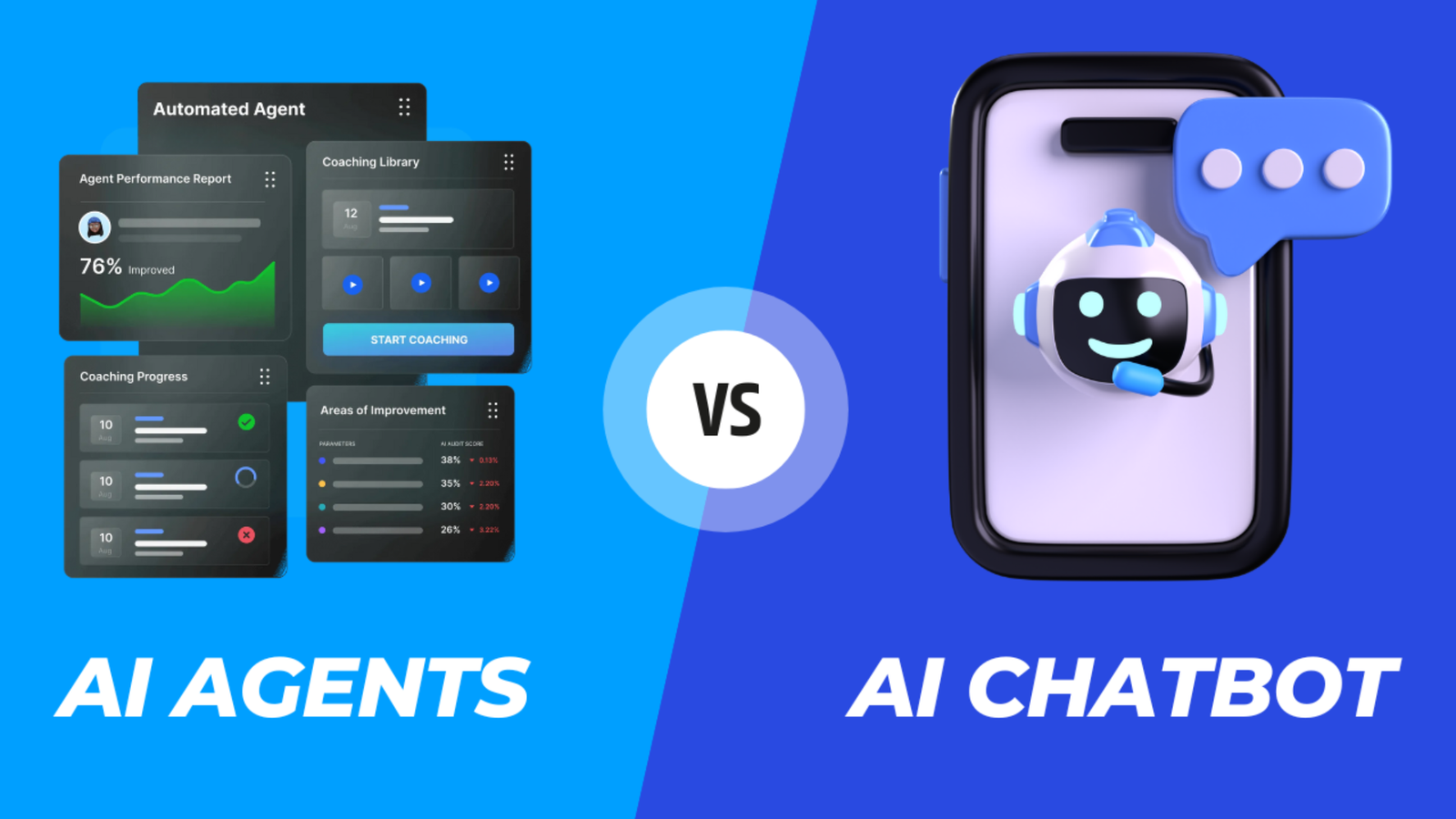
A chatbot responds, and an AI agent takes action, that’s the nutshell. A chatbot is a conversational interface that retrieves and presents information from a dataset. It’s essentially read-only. Ask it something and it pulls back text, a link, or a fact. An AI agent can reason its way through a goal, divide it into steps, and then execute those steps across different software systems; it is built on top of a Large Language Model. It has write access. It can call APIs, update databases, and make things happen on your behalf.
The flight example makes this concrete. Ask a chatbot to book you a flight and it shows you the schedule. Ask an AI agent and it checks your calendar, processes the payment, and emails you the boarding pass.
Architecture and what it means in practice
How chatbots evolved
Early chatbots were decision trees dressed up as conversations, rigid menus that guided users down predetermined paths. Modern chatbots are meaningfully better. Most now use retrieval-augmented generation, which lets them search through large company knowledge bases and return accurate, conversational answers. But they’re still reactive. They wait for a prompt, fetch relevant data, and stop. They don’t initiate anything and they don’t remember you next time.
How agents work differently
An AI agent runs a continuous reasoning loop. When you give it a goal, it plans the required steps, writes the API calls or code needed to carry them out, checks the result, and corrects course if something goes wrong. McKinsey’s research on generative AI describes this shift from reactive retrieval to proactive reasoning as one of the more meaningful changes happening in enterprise software right now.
Agents also maintain memory across sessions. They can recall what a user did or said days or weeks ago. Chatbots typically reset between sessions, which is why you end up re-entering your account number every time you open a new chat window.
When does each one make sense?
If your requirements are primarily informational, a chatbot will do the job well and cost far less to build. Good fits include:
- Answering the same questions repeatedly, pricing, delivery windows, store hours
- Helping staff find internal HR documents or compliance policies
- Filtering straightforward support queries before they reach a human agent
Cases where you need an agent
If the workflow requires end-to-end resolution, a chatbot won’t get you there. You need an agent when:
- A transaction spans multiple systems, cancelling an order, issuing a refund in Stripe, and updating inventory in your ERP all as one action
- In order to do cross-platform comparisons, the AI must be able to do things like compare Salesforce records with those in your billing system.
- The work is proactive rather than reactive, monitoring a server for anomalies and restarting services before anyone notices
- Research needs to run on a schedule, scraping competitor pricing each week and compiling a formatted report
The cost of each to build and run:
The cost gap is bigger than most people expect, and it comes down to engineering complexity. A standard chatbot build sits between £2,000 and £15,000. You’re essentially connecting an LLM to your documentation. Monthly expenses range from £30 to £200 and are kept low.
The scope of a project changes while developing a bespoke AI agent. Building expenses can range from well over £100,000, with the average starting at around £20,000. The reason is straightforward: because agents have write access to your systems, developers have to build strict safety boundaries, spending limits, and approval workflows before the system can go anywhere near production. Testing an agent takes five to ten times longer than testing a chatbot because engineers need to validate multi-step logic across thousands of edge cases. That complexity is reflected in running costs, which are about £500 to £5000 per month, depending on how it’s being used.
How we approach this at TekScrum
The most useful thing we’ve found is to start with the outcome you want, not the technology. An eCommerce client came to us wanting an AI agent for customer support. When we looked at their ticket data, 80% of queries were just “where is my order.” We built a RAG-powered chatbot connected to their shipping database instead. Ticket volume dropped 65% at a fraction of what an agent would have cost.
Automating vendor onboarding, data extraction from uploaded PDFs, compliance verification against public databases, Salesforce profile creation, and contract issuing was a necessity for a B2B logistics company. A chatbot couldn’t touch that workflow. We built a fully autonomous agent. Onboarding time went from three days to under ten minutes. It required serious API integration and safety guardrails, but the maths worked out: the system paid for itself within months by replacing manual administrative work.
The way we present it to clients: a chatbot redirects tasks, while an agent finishes them. If completing that work autonomously saves you three full-time administrators, the build cost looks different.
Faq’s
What is the core difference between a chatbot and an AI agent?
Chatbots retrieve and display information. AI agents execute multi-step tasks across external systems and can complete complex transactions without human involvement.
Do I need an AI agent for customer service?
Depends what you want it to do. If the goal is answering common questions and reducing ticket volume, a chatbot is enough. If you want the system to process refunds, update shipping details, and resolve account issues across multiple platforms, you need an agent.
How much does an AI agent cost compared to a chatbot?
Chatbots typically cost £2,000 to £15,000 to build. Agents start around £20,000 and can exceed £100,000 depending on the number of systems involved and the complexity of the tasks. Running costs are also higher.
What is the biggest risk when deploying an AI agent?
Giving it write access without proper guardrails. Agents can modify data, make purchases, and send emails, which means a poorly built one can corrupt databases or take unauthorised actions. Chatbots don’t carry that risk.
Can TekScrum help us figure out which one we need?
Yes. We audit your current operations, look at where the bottlenecks actually are, and recommend the most cost-effective solution, whether that’s deflecting queries or automating a full workflow.