

Pay-Per-Click (PPC) advertising remains one of the most effective digital marketing channels in 2026, especially for businesses that want fast visibility and measurable results. While organic marketing methods like SEO take time to build momentum, PPC allows brands to appear at the top of search engines almost instantly. However, the PPC landscape has changed significantly. Rising competition, smarter ad platforms, and greater informed users suggest that successful campaigns now rely closely on professional PPC control in preference to just ad spend.
What Is PPC Management?
PPC management is the process of planning, executing, monitoring, and optimising paid advertising campaigns across platforms such as Google Ads, Microsoft Ads (Bing), YouTube, Meta Ads, and other paid networks. Instead of paying for impressions alone, advertisers pay only when a user clicks on their ad, making PPC a highly performance-driven marketing model.
Effective PPC management goes far beyond launching ads. It involves keyword research, audience targeting, ad copy creation, bid adjustments, landing page optimisation, and continuous performance analysis. The intention isn’t always simply to force visitors, but to draw the proper customers who’re much more likely to convert into leads or clients.
Why PPC Management Matters More Than Ever in 2026
In 2026, the digital advertising landscape has reached unprecedented levels of competition. With the growing number of businesses investing in paid advertising, the average cost-per-click has increased across numerous sectors. Additionally, while advertising platforms are becoming increasingly automated, campaign management is becoming easier. However, without a distinct strategy, it will be increasingly difficult to differentiate from the competition.
Poorly managed PPC campaigns can drain budgets quickly without delivering meaningful results. This is why professional PPC management is critical. Businesses need ongoing optimisation, detailed performance tracking, and a strategic approach to targeting and messaging. Without these elements, even large ad budgets can fail to generate a positive return on investment.
Core PPC Management Strategies That Work in 2026
Successful PPC management in 2026 relies on a balance of automation and human decision-making. While platforms offer smart bidding and AI-driven tools, human oversight remains essential for controlling costs and improving performance.
One of the most effective strategies, which I consider to be the most important, is intent-based targeting of keywords. Instead of simply focusing on high-volume keywords, successful campaigns shift their priorities to search intent. Keywords indicating a customer’s intent to purchase or interest in a service generally lead to better conversions and, over time, are more cost effective.
Ad copy quality also plays a major role. Clear messaging, strong calls-to-action, and relevance to the user’s search query can significantly improve click-through rates. Regular A/B testing helps identify which headlines and descriptions perform best.
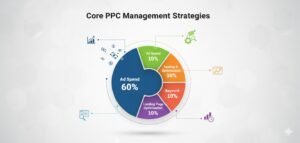
| Area | Percentage |
| Ad Spend | 60% |
| Testing & Optimisation | 15% |
| Keyword Research | 10% |
| Landing Page Optimisation | 10% |
| Reporting & Analysis | 5% |
PPC Costs in 2026: What Businesses Should Expect
PPC costs vary widely depending on Niche, competition, location, and campaign structure. In 2026, many businesses are seeing higher average CPC rates compared to previous years, especially in competitive areas such as legal services, healthcare, finance, and software.
Not all high expense campaigns will result in a loss of profitability. Here what matters is cost management within the budget. A good PPC campaign is designed to prioritize high quality traffic, over traffic in high volume. By excluding low-intent searches and audiences, businesses minimize their spend and optimize ROI.
Cost varies by area as well. Expert bid management is crucial for PPC campaigns aiming at US or UK cities because of the higher competition compared to smaller markets.
Real Results Businesses Can Achieve with PPC Management
When managed correctly, PPC delivers clear and measurable outcomes. One of the biggest advantages of PPC advertising is its ability to generate immediate results. Businesses can start receiving traffic, leads, and sales as soon as campaigns go live.
Increased website visibility, improved sales figures, higher quality leads, and better brand recognition are all positive outcomes and more brand recognition. PPC provides detailed analytics, which facilitates tracking of individual clicks, conversions, and costs. This transparency simplifies the strategy refinement process and the scaling of successful campaigns.
For local businesses, PPC can be especially powerful. Location-based targeting allows companies to reach users searching for services in specific cities or regions, making PPC a strong tool for local lead generation.
PPC vs SEO: Understanding the Difference
PPC and SEO are technical to digital marketing strategies, they have different functions. PPC provides instant visibility and is great to use for targeted promotions, seasonal deals, and launches. SEO is all about building long-term, sustainable, organic growth and authority for the brand.

| Month | PPC Results | SEO Results |
| Month 1 | High | Low |
| Month 2 | High | Medium |
| Month 3 | Medium | Medium |
| Month 6 | Medium | High |
In 2026, the most successful businesses will use PPC and SEO together. PPC provides quick wins and valuable data, while SEO builds sustainable traffic over time. Combining both channels allows businesses to dominate search results and maximise their online presence.
Why Hiring a PPC Management Agency Makes Sense
Effectively managing PPC campaigns requires time, skill, and consistent effort. Platforms get updated, competitive landscapes shift, and performance can change rapidly. For many businesses, managing PPC in-house becomes too much to handle.
- Reducing wasted ad spend
- Improving conversion rates
- Monitoring campaigns daily
- Adapting quickly to platform updates
- Providing clear reports and insights
Common PPC Mistakes Businesses Should Avoid
Many businesses struggle with PPC because of avoidable mistakes. These include targeting overly broad keywords, sending traffic to poorly optimised landing pages, ignoring negative keywords, and failing to track conversions properly.
Another common issue is setting campaigns and leaving them unmanaged. PPC requires continuous optimisation. Without regular adjustments, even well-designed campaigns can lose effectiveness over time. Avoiding these mistakes and focusing on long-term optimisation is essential for achieving sustainable PPC success.
Final Thoughts
PPC management in 2026 is no longer about simply running ads and hoping for results. It requires a strategic approach, careful budget control, and continuous optimisation. With rising competition and increasing costs, businesses that invest in professional PPC management are far more likely to achieve strong, measurable returns.